
This article was originally written in 1988 for the Chicago-area audio trade group EARS. It explains the causes and cures of analog tape hydrolysis (sticky-shed syndrome), a condition that continues to affect reel-to-reel master tapes today. While written in a conversational tone, the technical principles remain the same and are still applied in professional tape restoration. If you’re dealing with tape degradation or sticky-shed syndrome today, learn more about my reel-to-reel tape restoration services here.
Reprinted from The Engineering & Recording Society’s (EARS) EARDRUM
© Mike Konopka 1988
Tape Shedding: Has one of the following scenarios ever happened to you?
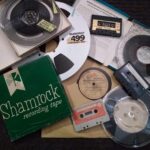
Tape Shedding Scenario #1:
One of your best clients has finally decided to mix those “killer tracks” you cut last year. After a 20 minute safari into the darkest corners of the studio’s tape vaults, you finally bag the precious reels. Cautiously, you “shuttle” rewind the masters which gives you time to configure the console in anticipation of a chart-topping mix-down. Suddenly, your “GRAMMY© acceptance speech” daydream is shattered by an occasional ticking sound coming from the whirling reels. There it is again! Snap! Crackle! Pop! Horrified, you find your “killer tracks” are littered with tiny random spot erasures rendering the masters quite useless!
Tape Shedding Scenario #2:
The phone rings. An anxious producer wants you to mix an album he tracked awhile ago across town at O. Howie Ream’em Studios. When the client arrives, you cue up his first master wondering what awful sounds lurk on the “other studio’s” reel. As you push up the faders, all the tracks just make this hellified screeching noise. And worse yet, oxides are starting to shed off the heads and guides of the multitrack. Even with audio turned off, the banshee-like noise emanates from the very tape machine itself!
Tape Shedding Scenario #3:
Sadness of sadness…due to the recession, it is announced that “Monumental Sound” is forever closing its hallowed doors. And an equipment auction date has been set. The big day arrives. With visions of tube mics, Fairchild limiters and other vintage goodies in your head, you arrive at the auction hours early. But, all you can find at the near empty “Monumental” is a couple of broken coffee machines, some Turner mics, and a 24 track calibration tape. The test tape looks pretty good, so you outbid the other auction vultures and still save yourself a couple hundred bucks. Back in your own studio, you decide to playback align your “out of whack” 24 track once and for all. But when you attempt to play this tape, the reels barely even turn: thick black gobs of oxide spew off the heads as your transport refuses to play this tape.
All of the above tape problems are related to “hydrolysis”, which is a problem inherent to tape binder formulation (polyester urethane) currently used by all tape manufacturers. Hydrolysis is one of the biggest problems facing tape manufacturers and the audio recording industry. And yet, it is one of the most widely misunderstood and least discussed problems. Tape manufacturers are not anxious to tell you that the recordings you are working so hard on today will turn into a pile of gooey crap in a few short years. But if you call your tape maker to complain about tape shedding, they know too well about this widespread problem. At The EARDRUM, we’ve made some calls and here’s what we’ve learned:
Are Your Analog Tapes Shedding?
Get Your Free Restoration Quote Now!
Analog Audio Tape Restoration Services
What Causes Tape Hydrolysis?
Three Factors Affect Breakdown of Tape Binders:
1.Humidity (above RH 40%);
2.Temperature (ideal storage 65 degrees );
3.Frequency of use.
Studios in humid climates (like Florida, New Orleans, etc.) can see tape shedding problems as early as one year. But in efforts to control elimination of hydrolysis, you could keep your tapes in a temperature and humidity controlled environment. Yet exposure to higher than 40% relative humidity for just one day will trigger irreversible hydrolysis which spreads, according to one tape manufacturer’s engineer “like a cancer through the entire tape pack”. Your attempts to seal the reel in plastic only traps existing humidity within the reel and can accelerate this tape binder breakdown.
Ampex senior product support engineer, Jay Zacharias, suggests sealing reels in plastic with a package of silica gel to remove existing moisture. Jay further suggests fast forwarding and rewinding all stored reels once a year to “air them out”. He also notes that customers that use the same reels over and over (like radio production users) seem to experience no hydrolysis problems. The more you use your reels the better.
Three Main Symptoms of Hydrolysis: (in progressive severity)
1. Higher than normal static discharge on winding. Static discharges are actually high voltage, low current spot erasures. (Scenario #1)
2. Audible squealing as tape “stutter-sticks” across tape machine heads and guides. Oxide starts to shed. (Scenario #2)
3. Finally, the tape machine downright refuses to play the tape. Severe oxide shed occurs during futile attempts to play the tape.
Also digital tape users beware: Even though digital tape’s higher metal particle content make it less prone to hydrolysis, it can and will still happen. And ADAT’s S-VHS tapes are formulated with standardized oxides and will likely experience shedding problems too.
Analog Tape Baking
These shedding tapes must be baked in a special oven at 130° ± 5° for 8 hours. Incubator type ovens are best as gas fired ovens impart moisture into the tape and are not as stable and accurate at keeping constant temperature. This baking process stabilizes the tape binder for short term periods of about 1 month. 130° is a pretty low temperature so don’t worry about melting plastic reels etc..
It’s a good idea to use a thermometer that’s accurate in this temperature range because most oven dials will probably be off a few degrees. Also, let the oven’s temperature stabilize for 30 minutes before baking your tapes. After baking, it is critical to allow a 24 hour room-temperature cool down period so the binder will set. Playing tapes right out of the oven can wipe oxides right off the mylar!
Some tapes will require two baking treatments before use , so scrutinize your once baked reels for signs of further shedding. In addition to short term stabilization of the binder, baking brings tape lubricants to the surface of the tape. These lubricants allow the tape to run through your transport smoothly. Unfortunately, subsequent use of baked reels depletes the lubricants. This means your hydrolyzed tapes can only be baked and used 2-3 times before they are lost forever. Therefore consider dubbing your baked reels to archival formats for longer term storage.
Analog Tape Storage Guidlines
Store tapes with reels wrapped in plastic only when using silica gel packets (available at American Science & Surplus, 5696 N. Northwest Highway, Chicago, IL). Storage room temps should be an ideal 65° with 40% relative humidity. Also, annually shuttle wind reels to “air them out”.
The Eardrum spoke with Ampex, Magnetic Reference Laboratories, (the test tape people) and EARS’s own Jeff Hamilton of BASF about policies concerning hydrolyzed tapes. These companies will help you with your problem tapes if you call them. Ampex’s helpful Senior Product Support Engineer Jay Zacharias told The EARDRUM that Ampex will bake your shedding Ampex tapes for no charge (except shipment to Ampex). MRL Labs has a credit policy toward purchase of a new test tape (on the tape of your choice) based on the age of your shedding tape. BASF’s Jeff Hamilton says that their binders in use since 1972 have experienced no breakdown problems. Jeff also notes that BASF manufactures BASF 911 test tapes as well. © Mike Konopka 1988

Are Your Analog Tapes Shedding?
Get Your Free Restoration Quote Now!
Analog Audio Tape Restoration Services